Table of Contents
- Introduction: Why Cabinet Board Selection Matters for Overseas Import Projects
- Basic Definition & Manufacturing Difference of Plywood, MDF, Particleboard
- Side-by-Side Performance Comparison Table
- Breakdown for Each Board Type (Pros, Cons, Suitable Regions & Project Scenarios)
- Material Selection Advice by Target Market Climate
- Cost, MOQ & Shipping Consideration for Bulk Cabinet Import
- Final Recommendation for Different Overseas Buyer Types
- FAQ
1. Introduction: Why Cabinet Board Selection Matters for Overseas Import Projects
When importers, property developers, contractors and residential wholesale buyers source custom kitchen cabinets from China, substrate material selection directly impacts long-term usage durability, cross-ocean shipping damage rate, after-sales complaint rate and overall project budget.
Overseas projects face variable conditions: high humidity coastal areas in Australia, cold dry winters in Northern Europe, hot arid weather in the Middle East, and strict formaldehyde emission standards across EU and US markets. Plywood, MDF and particleboard are the 3 most widely used cabinet base materials globally, but wrong material selection will lead to cabinet warping, swelling, paint peeling and high return costs after long sea freight transit.
This guide compares performance, cost, compliance and adaptability of three mainstream boards, to help you pick the most cost-effective option for your overseas cabinet procurement project.
2. Basic Definition & Manufacturing Difference of Plywood, MDF, Particleboard
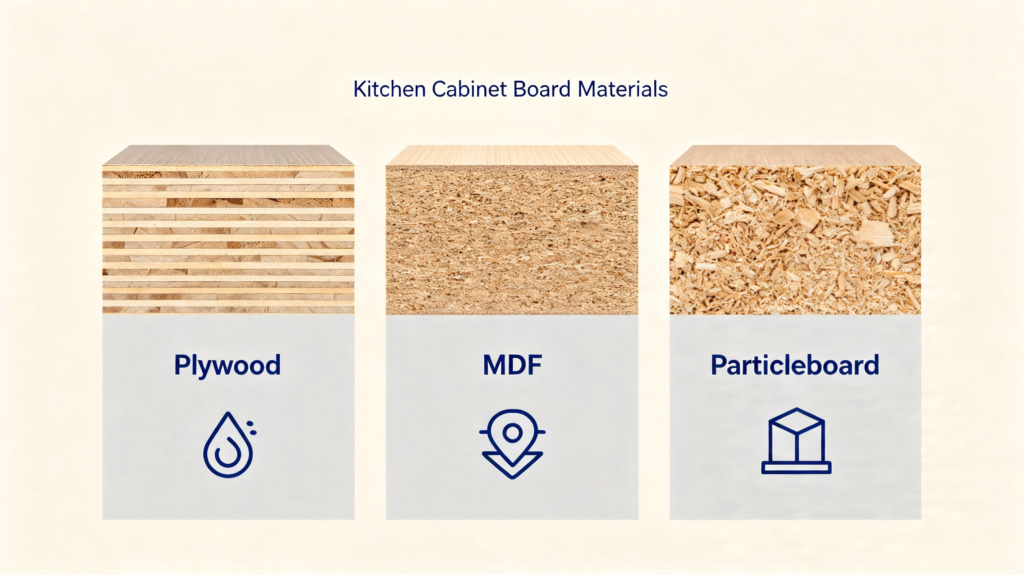
Plywood (Multi-layer Wood Board)
Made of multiple solid wood veneers glued and hot-pressed with cross-grain stacking structure. Each adjacent wood layer arranges grain in opposite directions, greatly improving structural stability. We use waterproof phenolic glue for export-grade plywood, compliant with CARB P2 / E0 formaldehyde standards.
MDF (Medium Density Fiberboard)
Grind wood raw materials into fine wood fibers, mix with resin adhesive then hot press into dense, smooth board surface. Uniform texture is ideal for fine painting, matte/UV finish and detailed cabinet door carving.
Particleboard / Chipboard
Compress chopped wood chips, wood shavings with adhesive under high pressure. Low raw material cost, flat surface, mostly used for low-budget mass housing projects with dry indoor environments.
3. Side-by-Side Performance Comparison Table
| Evaluation Dimension | Plywood | MDF | Particleboard |
|---|---|---|---|
| Moisture & Water Resistance | ★★★★★ Excellent | ★★ Average | ★ Poor |
| Structural Stability / Anti-warping | ★★★★ Great | ★★★ Moderate | ★ Low |
| Surface Finishing Effect | ★★★ Good | ★★★★★ Best | ★★★ Acceptable |
| Screw Holding / Load Bearing | ★★★★★ Strong | ★★ Normal (easy to strip screws) | ★ Weak |
| Formaldehyde Control Ease | ★★★★ Easy to meet E0/CARB P2 | ★★★ Requires strict glue control | ★★ Higher emission risk |
| Weight for Sea Shipping | Medium | Heavy | Lightest |
| Unit Material Cost | Highest | Mid-range | Lowest |
| Recommended Service Life | 15–25 years | 8–12 years | 5–8 years |
4. Breakdown for Each Board Type (Pros, Cons, Suitable Regions & Project Scenarios)
4.1 Plywood
Advantages
- Outstanding waterproof and anti-deformation performance, tolerates humidity fluctuation during long sea transportation and coastal city usage
- Excellent screw retention, hinges and drawer rails stay firmly fixed after years of opening and closing
- Less expansion rate when exposed to occasional water splashes from kitchen sinks
- Easy to pass strict environmental certification for EU, US and Australian markets
Disadvantages
- Higher material cost, raising total cabinet quotation
- Harder to do ultra-fine engraving than MDF
- Slightly heavier, increasing container shipping weight cost
Best-fit Scenarios & Regions
- Coastal cities of Australia, Florida USA, Southeast coastal Europe with high air humidity
- High-end residential villas, hotel projects, long-term rental apartments
- Projects requiring 10+ year warranty for cabinet quality
4.2 MDF
Advantages
- Ultra-smooth board surface, perfect for matte lacquer, high-gloss UV coating and modern minimalist cabinet styling
- Consistent density, suitable for intricate door panel milling and decorative grooves
- Mid-level budget, balances appearance quality and procurement cost
Disadvantages
- Swells quickly once water penetrates unsealed edges, must do full edge sealing treatment
- Poor screw holding capacity; repeated disassembly will cause hole loosening
- Not fit for locations with persistent high humidity
Best-fit Scenarios & Regions
- Inland dry areas of Europe, North America and Middle East cities with low ambient humidity
- Modern style residential projects focusing on cabinet appearance
- Mid-range apartment fit-outs with stable indoor air conditioning
4.3 Particleboard
Advantages
- Lowest material cost for large-batch mass housing projects
- Light weight, reduces ocean freight cost per unit
- Flat surface works well for laminated veneer finish
Disadvantages
- Severe swelling and permanent damage upon water contact
- Weak load-bearing capacity, easy to sag for wide cabinet shelves
- Harder to meet strict low-formaldehyde standards for Western developed markets
Best-fit Scenarios & Regions
- Low-budget temporary housing projects, inland dry public housing programs
- Markets with loose environmental and durability requirements
- Short-term renovation projects with usage cycle under 6 years
5. Material Selection Advice by Target Market Climate
1. Australia / New Zealand coastal zones, Mediterranean Europe
Prioritize waterproof grade plywood; avoid particleboard completely, MDF only acceptable for fully air-conditioned indoor apartments
2. Northern & Central Europe, inland USA & Canada
MDF for high aesthetic demand projects; plywood for kitchen zones near windows with humidity changes
3. Middle East Gulf Countries
Indoor spaces run constant AC: MDF is cost-effective; outdoor/half-open kitchen cabinets must use plywood
4. Southeast Asia tropical markets
Only export-grade waterproof plywood is recommended for all kitchen cabinet projects
6. Cost, MOQ & Shipping Consideration for Bulk Cabinet Import
- Material Cost Gap: Particleboard < MDF < Plywood, plywood can raise total cabinet material cost by 18%–30% compared with particleboard
- Packaging Difference: MDF and particleboard need extra waterproof wrapping inside crates for sea transit; plywood has lower requirement for waterproof packaging
- Container Load: Particleboard is lightest, allowing more cabinet sets per 40HQ container; plywood adds overall gross weight
- Compliance Cost: Plywood is easier to obtain CARB P2, CE, Australian AS/NZS formaldehyde certification, cutting third-party testing fees for customs clearance
7. Final Recommendation for Different Overseas Buyer Types
- High-end villa / hotel / long-term rental investors: Choose waterproof plywood as cabinet substrate
- Mid-range residential developers focusing on modern design, dry inland locations: Select MDF with full edge sealing and premium paint finish
- Low-cost mass public housing projects in stable dry inland regions: Adopt particleboard with melamine lamination
If you have specific destination country, project budget and warranty requirement, our team can customize cabinet material solution and provide detailed FOB quotation breakdown for your overseas project.
8. FAQ
Q1: Can I mix plywood for cabinet frame and MDF for door panels?
A: This is the most popular cost-saving solution for export orders. Plywood guarantees cabinet body durability, MDF delivers smooth painted door finish, widely adopted by Australian and European importers.
Q2: Which board meets EU E1 and US CARB P2 formaldehyde standards easily?
A: Export phenolic glue plywood has the highest pass rate; MDF and particleboard need stricter factory glue formulation control and third-party testing.
Q3: Will humidity during ocean shipping damage MDF cabinets?
A: If sealed with full edge banding and waterproof crate packaging, short transit is acceptable; prolonged high humidity storage will still lead to edge swelling risk.
Q4: What is the typical warranty difference for 3 materials?
A: Plywood cabinets: 10–15 year structural warranty; MDF: 5–8 years; particleboard: 2–3 years for structural quality.